
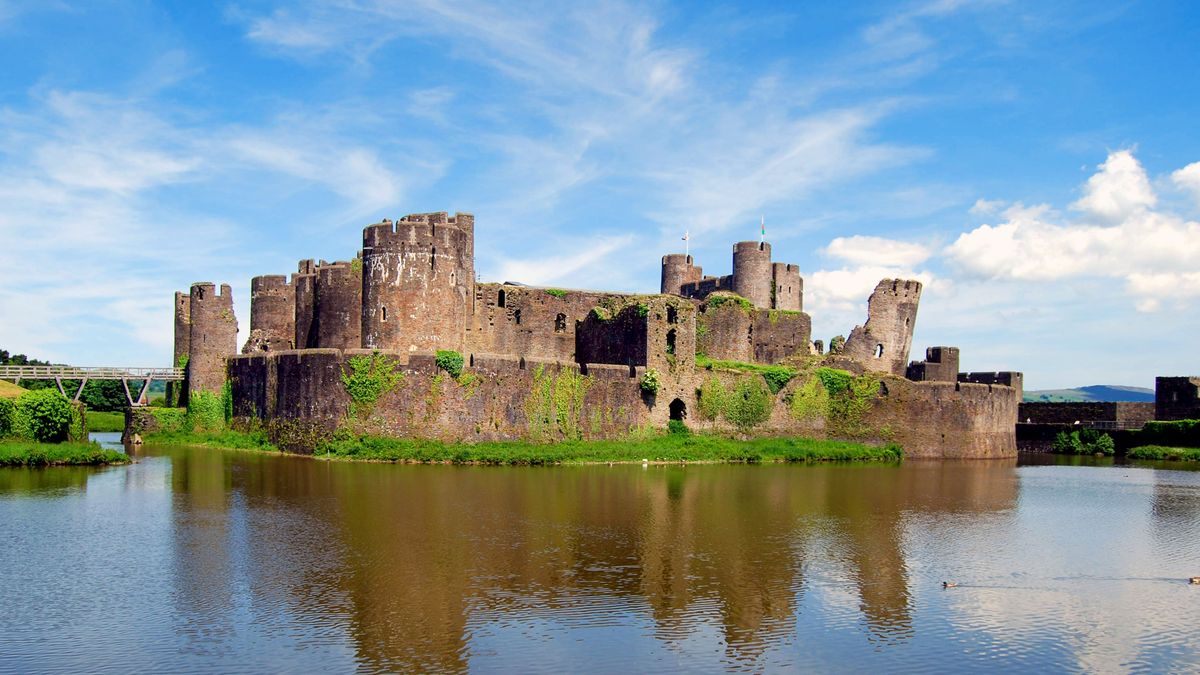
The word eisteddfod means "a sitting" — from eistedd, to sit — and that reveals a good deal about its origins. These were gatherings where poets and musicians sat down together, performed, and were judged. The tradition reaches back to the twelfth century, when Rhys ap Gruffydd is said to have held a festival of poetry and music at Cardigan Castle in 1176. What survives today is not a museum piece but a living competition circuit, running from village halls right up to a vast travelling national festival.
If you have never been to one, the atmosphere can take you by surprise. It is part village fete, part serious arts festival, part family reunion — and the Welsh language is the thread that holds the whole thing together.
The National Eisteddfod (Eisteddfod Genedlaethol Cymru) is the big one. It takes place during the first week of August and travels to a different part of Wales each year, broadly alternating between north and south. Because it moves, host communities spend years preparing for it and years afterwards talking about it.
A few practical things are worth knowing before you go:
The ceremony most people have heard of is the Chairing of the Bard, held on the Friday afternoon. A poet wins the chair for an awdl — a long poem written in the strict metres of cynghanedd — and the ceremony, complete with the Gorsedd robed in blue, green and white, is genuinely stirring even if you do not speak a word of Welsh.
The Crown is awarded for a free-metre poem, and the Prose Medal for a substantial work of prose. There is also a prize for a novel and the Welsh Learner of the Year award, which many newcomers find the most encouraging part of the week. If the chair is withheld because no entry reaches the required standard, the empty chair is a moment of real disappointment for the whole field.
Not every eisteddfod is national. Hundreds of smaller ones take place every year: chapel and village eisteddfodau, school eisteddfodau, and the Urdd's regional and national youth festivals, which rank among Europe's largest gatherings of young performers.
For families, these are often the entry point. Children compete in recitation, singing, folk dancing and instrumental classes, and the skills learned on those stages feed directly into the national competitions later on. Plenty of Wales's best-known performers began as seven-year-olds nervously reciting a verse or two in a school hall.
Welsh is the default language of the Eisteddfod, and that is entirely deliberate. The festival exists partly to give the language a public, celebratory and unapologetic space — somewhere it is simply the normal language of daily business rather than a novelty.
That said, non-Welsh speakers are genuinely welcome. Many venues offer translation headsets, and the programme is bilingual. If you are learning, a few things help:
Going for a day is straightforward. Check the dates for that year, book accommodation early — the host town fills up fast — and wear comfortable shoes, because the Maes is far bigger than it looks on a map. Bring layers too; Welsh August weather is not to be trusted.
If you fancy competing, study the syllabus, which lists every class, age group and rule. Entries usually close in the spring. You do not need to be an expert: there are classes for beginners, for learners, for families and for choirs who simply enjoy singing together. The Eisteddfod is not only for the gifted — it is for anyone willing to stand up and have a go.
And that, in the end, is the point. The Eisteddfod survives because ordinary communities keep turning up, keep writing, keep singing, and keep the language alive in the most public way they can.

Hi, my name is Anthony kuber. I am artist and fashion designer.
I love to travel and writing blogging.
Your email address will not be published. Required fields are marked *
Software Developer & Writer
Hey, I'm Diva, a developer and writer blending code and creativity. I'm driven by a deep curiosity and a relentless pursuit of excellence. Join me as I craft digital solutions and captivating stories.


